
Vitamin C Supplement Side Effects: The Cost of More
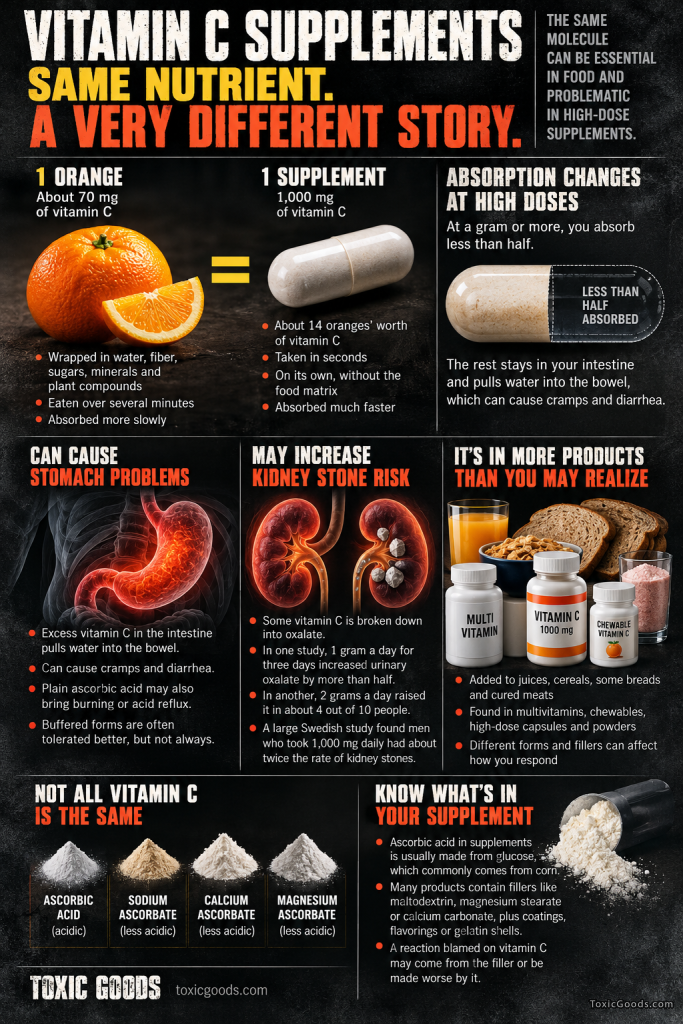
A 1,000 mg vitamin C supplement delivers roughly fourteen oranges’ worth of the nutrient in seconds. In a Swedish study following more than 23,000 men, supplements typically containing that dose were associated with about twice the rate of kidney stones.
 That is an awkward detail for a vitamin with such a harmless reputation. The familiar reassurance is that vitamin C is water-soluble, so your body uses what it needs and flushes out the rest. But passing something out of the body does not mean it caused no trouble along the way.
Vitamin C is essential. That does not make every dose, formulation or reason for taking more equally sensible. And vitamin C supplement side effects are easier to overlook when ascorbic acid also appears in fortified juices, cereals, some breads and cured meats, while additional doses arrive through multivitamins, chewables, capsules or powders.

Vitamin C: Is It Really Harmless?
Vitamin C is one of those supplements people rarely think twice about. It’s familiar, widely recommended and generally treated as harmless. But when it comes to the potential consequences for your kidneys, that reputation deserves a closer look.
The Toxic Goods investigation examines the assumptions behind vitamin C supplementation and some uncomfortable questions that don’t usually come up when people are told to take more of it.
What changes between an orange and a vitamin C pill?
Sometimes, surprisingly little about the vitamin itself. Ascorbic acid in a supplement can be chemically identical to the ascorbic acid in an orange. What changes is the delivery.
A medium orange contains about 70 mg of vitamin C, alongside water, fiber, sugars, minerals and other plant compounds. Eating it takes time. A 1,000 mg tablet packs approximately fourteen times that amount into a dose you can swallow almost immediately.
Studies comparing oranges, juice and broccoli with synthetic vitamin C found broadly similar total amounts absorbed. But total absorption isn’t the whole story. How quickly the dose arrives, or where unabsorbed vitamin sits, can matter too. The familiar comparison between “natural” and “synthetic” misses much of that.
Vitamin C supplement side effects start before it is absorbed
Your gut handles what your body does not take up
According to the NIH Office of Dietary Supplements, absorption falls below half at doses of a gram or more. Unabsorbed vitamin C remains in the intestine and draws water into the bowel. That can mean cramping and diarrhea.
Those symptoms are often filed away as minor digestive inconvenience. Fair enough, until it is your gut doing the accommodating. Plain ascorbic acid can also cause burning or acid reflux. A buffered version may be easier to tolerate, but changing the acidity does not erase every other issue associated with the dose.
Chewable vitamin C puts the acid against your teeth
Chewable vitamin C has been measured at a pH of about 2.3. Tooth enamel begins dissolving below roughly pH 5.5. On the acidity scale, that chewable was more than a thousand times more acidic than the threshold described above.
The contact is direct and repeated. Reports described people who chewed vitamin C supplements most days for years and developed severe tooth erosion. Enamel does not grow back. A product sold as an easy way to take a healthy nutrient can still be hard on the surfaces it touches before reaching the stomach.
The kidney stone signal at 1,000 mg a day
Part of the vitamin C the body breaks down becomes oxalate, a component of the most common type of kidney stone. In one short study, adults taking 1,000 mg daily for three days had a rise of more than 50% in urinary oxalate. In another, 2,000 mg daily increased urinary oxalate in about four out of ten participants. Not everyone responded the same way.
Longer-term findings raise a separate concern. A study of 23,355 Swedish men followed participants for roughly eleven years. Men using vitamin C supplements, typically containing 1,000 mg, had approximately double the rate of kidney stones. Daily users had the highest risk. That association does not mean every user will develop stones, but it is a poor fit for the idea that excess vitamin C simply disappears without consequences.
For comparison, multivitamin users received substantially less vitamin C and showed no consistent increase in stone rates. The stated upper limit is 2,000 mg per day. A population-wide limit is not a personal guarantee that half as much cannot cause problems.
What else is in that “vitamin C” product?
Most supplemental ascorbic acid is manufactured from glucose, commonly sourced from corn. The resulting ascorbic acid is heavily purified. Production origin alone does not establish what remains in a finished product or what might cause a particular reaction.
Form also matters. Plain ascorbic acid is acidic. Sodium ascorbate, calcium ascorbate and magnesium ascorbate bind the vitamin to a mineral, making the product less acidic and sometimes better tolerated. Tablets and capsules may also contain maltodextrin, magnesium stearate, calcium carbonate, coatings, flavorings or gelatin shells.
“Inactive ingredients” is a convenient label. It still doesn’t tell someone who reacts differently to two products which component is responsible. The video explores a particularly telling gap between a supplement’s front-label claim and the raw materials described by its manufacturer. It also makes clear that the resulting reaction could not be pinned on a specific cause.
Why do some people feel tired while others feel wired?
People have reported fatigue, fogginess, agitation, poor sleep and even shortness of breath after vitamin C supplements, including doses from about 200 to 1,000 mg. One person reported fatigue at roughly 50 mg. Those accounts don’t prove vitamin C caused the symptoms. But a complaint shouldn’t be dismissed solely because the dose looks ordinary.
Vitamin C participates in the conversion of dopamine to norepinephrine, which is involved in alertness. Without a vitamin C deficiency, though, taking more wouldn’t be expected to speed up that process. And gradual changes in mineral balance wouldn’t readily explain feeling exhausted soon after a single dose.
The cause of those rapid, conflicting reactions remains uncertain. A formula’s acidity or added ingredients may matter. So might individual responses that current explanations do not capture neatly. The important distinction is between a reported symptom and an established mechanism.
When a claimed benefit has an awkward downside
Vitamin C is sometimes promoted for its antihistamine effect. Relief can feel like resolution, but reducing a histamine response does not necessarily identify or remove whatever triggered it. Some people describing histamine intolerance report symptom flares with certain vitamin C products, yet tolerate other formulations. The specific culprit may be the acidity or other ingredients rather than the vitamin itself.
The tradeoff with iron is clearer. Vitamin C improves absorption of iron from plant foods. For someone with hemochromatosis, a condition in which iron accumulates to harmful levels, that same effect can worsen iron overload. Excess iron can damage the liver and heart. U.S. health guidance says doctors may recommend avoiding vitamin C supplements in this situation.
For a closer look at those harder-to-explain reactions, watch the accompanying Toxic Goods video. It includes the presenter’s own experience and his interpretation of what a concentrated dose may set in motion.
The unanswered question about years of concentrated doses
The presenter also raises a longer-term concern about repeatedly taking a concentrated acidic dose. The body regulates acidity through several mechanisms, including the kidneys and bicarbonate. He suggests that a recurring acid load could put pressure on mineral balance, potentially including calcium from bone, particularly when kidney capacity is reduced.
That proposed long-term consequence is an interpretation, not a demonstrated result. The studies discussed do not establish what decades of gram-level daily doses do to bone and mineral balance. It’s worth keeping that question separate from the better-described digestive, dental and kidney-stone findings instead of treating everything as proven “vitamin C toxicity.”
Before taking another concentrated dose
Look beyond the nutrient name on the front of the bottle. Consider how much vitamin C you are getting at once, including from fortified foods and other supplements. Check whether the product contains plain ascorbic acid or a buffered form, and read the ingredients that accompany it.
If an unwanted response keeps turning up with the same formulation, it’s worth noticing without assuming the vitamin is necessarily the cause. Ask what you expect the extra dose to do. If a doctor has prescribed a specific treatment, discuss changes with them first.
Vitamin C deserves its place in ordinary nutrition. A concentrated supplement still deserves questions. The label may name an essential nutrient; it cannot promise that more of it is automatically better for every body.